 PactYield
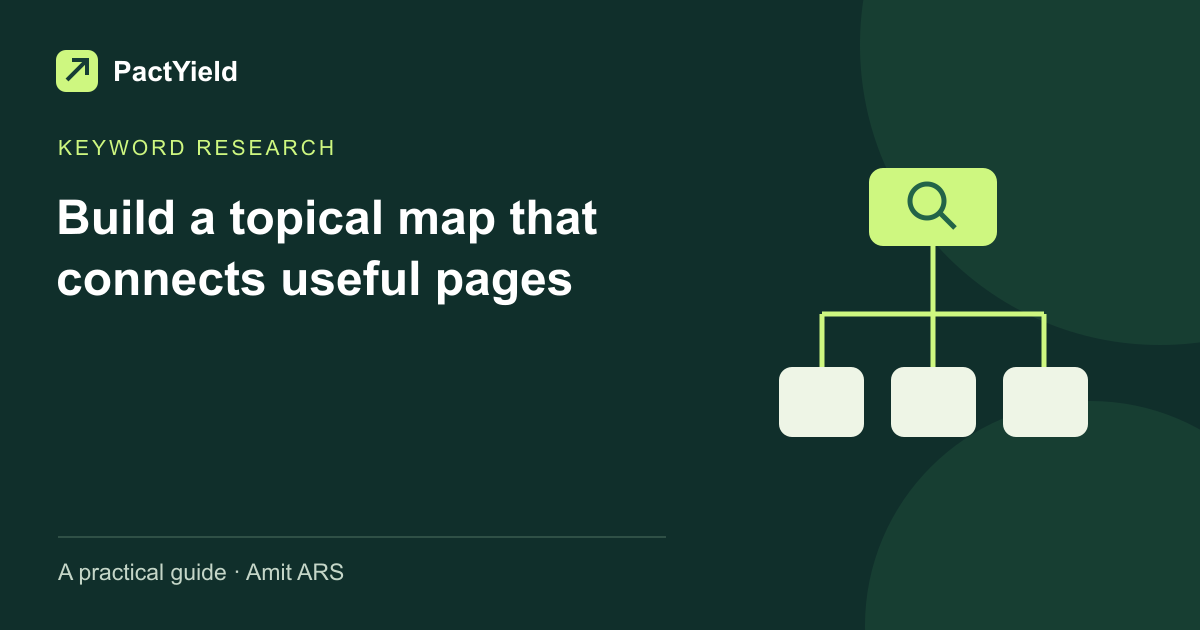
A topical map is a plan for the questions your website should answer and how the relevant pages connect. It is most useful when every planned page has a distinct purpose. A large list of keyword variations alone is not a content strategy: you need to decide which ideas belong together and what a reader should do next.
Begin with an audience and a main topic
Write down the audience, the problem they are trying to solve, and the service or outcome your website supports. For a website-maintenance business, the central topic could explain what maintenance includes, who needs it, and how to choose the right support.
Use the main page to orient readers. Supporting pages should go deeper into specific questions without repeating the same general introduction. Keep a short purpose statement next to each proposed URL so you can spot ideas that do not justify a separate page.
Separate services from supporting questions
A service page can explain the offer, process, boundaries, evidence, and contact action. Supporting articles can answer questions that arise before or after someone chooses that service. Both should be useful independently.
For a WordPress maintenance service, possible articles include a maintenance checklist, a backup workflow, update testing, troubleshooting downtime, and planning a maintenance budget. These are examples to evaluate against your audience, not a required quota of pages.
- Give each page one primary task for the reader.
- Combine close variations when the same explanation answers them well.
- Check existing content before creating a new URL.
- Compare search results manually when the intended page type is unclear.
Plan links with a reason and a destination
Connect a supporting article to the relevant service when that service helps with the problem being discussed. Link from the service page to guides that explain common questions in more detail. A reader should understand why the next page is useful before clicking.
Create a simple link worksheet with the source page, destination page, suggested anchor, and reason for the link. Avoid placing the same block of keyword-heavy links on every page. A relevant contextual link is easier to understand than a long list added only to increase the link count.
Publish a coherent first group
Start with the main page and a small set of strong supporting articles. Before publishing, verify that the promised destination pages exist, breadcrumbs work, and the navigation provides a route back to the topic. Do not leave visitors following links into unfinished drafts.
Review the map as you learn from client questions and website performance. Add an article when a useful question is missing, merge pages when they repeat one another, and update internal links when a destination changes. The map should help you maintain the website, not pressure you to publish unnecessary content.
Draft your page structure in Keyword Finder & Topical Map, then review the proposed topics and links against your actual website.
Open the related PactYield tool →Frequently asked questions
Does every keyword need its own page?
No. Closely related phrases may be answered well by one page. Create another page only when it serves a meaningfully different reader task or needs its own explanation.
How many supporting articles do I need?
There is no universal number. Cover the useful questions your audience has, with enough depth to answer them clearly. Avoid creating filler to meet a page-count target.
Should supporting articles link back to the service?
Yes, where the service is a useful next step. Explain the connection naturally and link to the most relevant destination rather than inserting an unrelated sales link.
Related articles
Run an internal link audit with a clear next step
Review where internal links lead, repair confusing paths, and connect articles to useful service pages without adding clutter.
How to read keyword rankings across countries
Understand country-specific ranking snapshots, compare like-for-like checks, and use the results to investigate the right pages.
Turn keyword ideas into a useful content brief
Build an article brief around the audience, question, examples, sources, and next action so writing starts with a clear purpose.
References used in this guide

About the author
Amit ARS
Website Designer & SEO Expert
Amit Ranjan, also known as Amit ARS, is a website designer and SEO expert working in this field since 2020. He helps businesses build better websites through design, WordPress, SEO, performance, security, and content strategy.

